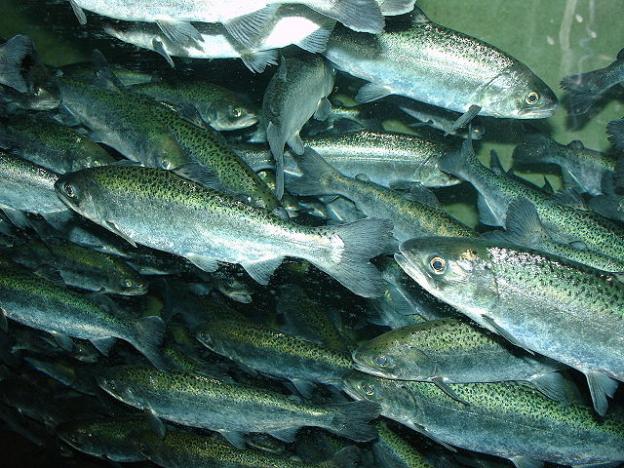
Drivers are set to give California salmon truck rides up and down the West Coast as the drought makes the fish's traditional river migration impossible.
by Hannah Moore
May 18, 2015—Instead of swimming downstream to the San Francisco Bay this year, California salmon are getting rides.
Due to dried riverbeds and sauna rocks caused by the drought, the salmon can’t take their normal journey to the Pacific Ocean. The rivers are deemed too warm and dry for the fish to safely swim through. So state and federal wildlife agencies are stepping in and giving “fish lifts” to help the salmon make this trip, reported ABC News.
It will be one of many such trips for fish up and down the West Coast.
Considered the largest fish lift in California history, the statewide effort involves eight 35,000-gallon trucks transporting 30 million salmon. Stafford Lehr, chief of fisheries for California Department of Fish and Wildlife, has been working to get the fish downstream by truck since February, according to The Inquisitr.
Last year, 95 percent of the winter run of Chinook salmon died. The drought and heavy farm and city use of water has had dire consequences for California’s native fish. The fish are vitally important to the state’s fishing industries and to the food chain.
Sixty miles of the San Joaquin River have dried up due to the drought and heavy irrigation use of the river’s water. The river routes to and from the San Francisco Bay that salmon have taken for millions of years are replaced with a 90-minute drive down Highway 99 in a truck.
While the rivers aren’t safe for the fish, these truck rides aren’t always either. In January, a truck driver charged with drunk driving hit a pole and 11,000 salmon fell into the road and died.
The endangered Coho salmon and other native fish are seldom seen because of the drought. Watershed biologist Preston Brown found none of these fish in a coastal tributary where, decades ago, so many lived in the water that the sound of their jumping kept some people awake at night.
Brown and a local environmental group, Salmon Protection and Watershed Network, are set to search this waterway starting in June—an earlier starting date than usual due to the drought. Brown and the group will attempt a search-and-rescue for Coho salmon and other fish stuck in dry, water-lacking pools.
According to Brown, sometimes the help arrives too late. The salmon who survive predator attacks die from drying up.
Given the disappearance of creeks and rivers, two or three truck rides are set to carry some steelhead trout from Southern California this summer.
California is currently in its fourth year of drought. The statewide water shortage is the most severe California has ever seen. It has had negative consequences for farms, wildlife and residents.
Category: