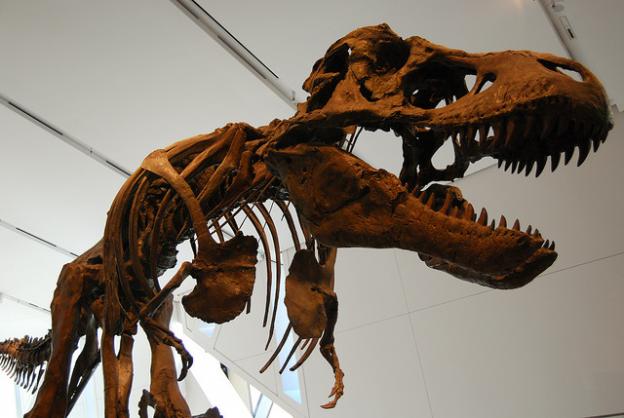
Paleontologists have argued since the 19th century about whether the fearsome creatures were warm-blooded or cold-blooded.
by Hannah Moore
June 2, 2015—Despite their intimidating, cold-blooded reputation, dinosaurs may have been warm at heart.
Paleontologist Michael D’Emic said, in new commentary published in the journal Science on May 29, that he has found evidence in dinosaur bones indicating the ancient reptiles were warm-blooded, according to Discover Magazine.
The commentary is a criticism of a study conducted last year by biologist and author John Grady of the University of New Mexico, who isn’t persuaded by D’Emic’s response, reported National Geographic.
About a year ago, a study published in Science took a look at dinosaur growth rates to analyze their physiology. The study evaluated the metabolism of 21 dinosaur species by gathering information on dinosaurs’ body mass shown by the size of their thigh bones, and growth rates shown by rings in fossils. Like in tree rings, the spaces between the fossil rings show periods of both rapid and arrested growth. Lines of arrested growth—LAGs—are thought to be deposited once a year, which gives an estimate of when the dinosaur passed.
The study concluded that dinosaurs were most likely mesotherms, which means they could maintain a body temperature higher than that of their environment, but not at a fixed point.
The idea that dinos were mesotherms is criticized by D’Emic. He argues that the growth rate estimate made two mistakes: the researchers didn’t adjust for differences in the length and number of days at different times of the Mesozoic, and the daily growth estimates assumed that dinos grew at a fixed rate during the year.
D’Emic says that dinosaurs probably grew sporadically depending on the seasons, gaining weight during wet periods when food was more plentiful and experiencing stalled growth during dry times.
Although the authors of last year’s study admit to some minor errors in their data, they disagree with D’Emic’s argument and stand by all of their original conclusions.
“Comparing dinosaur growth with the observed growth rate of living vertebrates clearly shows that non-avian dinosaurs were mesotherms,” Grady told Reuters.
Scientists are still trying to find the best way to estimate growth rate of dinos. This could result in a variety of viewpoints on dinosaur physiology, which means Grady and D’Emic could both be right. It would be surprising if all dinosaurs shared the same physiology.
D’Emic hopes to test his theory further by analyzing bones from more of a variety of dinosaur species than were featured in the original study.
Photo by Mike Shaver / CC
Category: