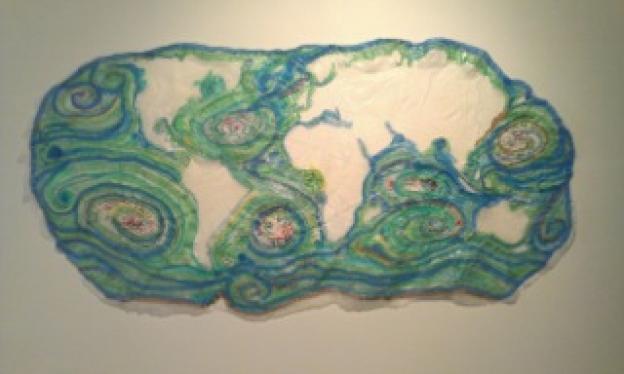
The Plastic Paralysis art show will feature work by Silicon Valley and Santa Cruz artists that highlights the rise of plastics in our oceans.
by Hannah Moore
June 9, 2015—An eco-themed month at Studio Bongiorno is close-approaching. The series of environmentally-focused events will kick off June 12 with the Plastic Paralysis art show.
Hosted by artist and art curator Robin Lysne, the event will debut artwork inspired by the environmental harm caused by the Great Pacific Gyre, a collection of litter in the North Pacific Ocean.
The art will be on display at the Santa Clara gallery through July 11.
Plastic Paralysis will show paintings, sculptures and photography from the artists—including Lysne, who will contribute two pieces.
“Art is the first line of awareness in culture,” she said on the power of art to direct attention to issues. “If artists are bringing it into the culture, it’s an issue, and we need to bring this issue out immediately.”
According to Lysne, artists are increasingly bringing this issue out through their work.
“I was really surprised at how many artists are using plastics in their artwork (partially) to raise awareness (of plastic dangers). It’s a new phase of art,” she said, adding that she learned that many such artists get their material off of the beach.
Lysne mentioned a piece to appear in Plastic Paralysis called “What the fish told me,” which consists of a man being spoken to by nature. This is precisely what Lysne said we need to do.
“We need to speak to nature,” she said. “We need to figure out how we can work in more compatibility with nature and ask ourselves why we’re doing this to our ocean.”
The Great Pacific Gyre, also known as the Great Pacific Garbage Patch, was discovered in 1997 by Captain Charles Moore. The marine debris cluster is two times the size of Texas and is surrounded by four currents that move clockwise around a 7.7 million square-mile area.
The currents move the trash to a central point in the ocean, where the garbage becomes trapped. That center is still, but the moving currents surrounding it makes access to the Gyre difficult. The Gyre endangers fish and wildlife as well as the ocean.
“When we realize plastic is everywhere, we need to find a new way to package things,” said Lysne.
She said she hopes the show will inspire people and raise questions about alternatives and our culture.
“We have cultural assumptions that it’s okay to use plastic,” she said.
As a complement to Plastic Paralysis, environmentalist and artist Chris Arcus and artist Bea Garth will co-host EcoViewing on June 26 at the Studio.
EcoViewing is a Studio Bongiorno event that shows films in hopes of raising awareness of environmental issues and encouraging discussion of solutions. This month’s film, called Plasticized, will be about the discovery of the 5 Gyres.
“The goal of EcoViewing is to get the community engaged in activism, what goes on in our world and the nature sacrificed,” said Arcus. “I hope (Plasticized) will get people engaged—not passive or thinking other people can do the work for them.”
Moore is scheduled to speak at Studio Bongiorno on June 22, to show slides of the Gyre and discuss what we can do about plastics in the environment.
Category: